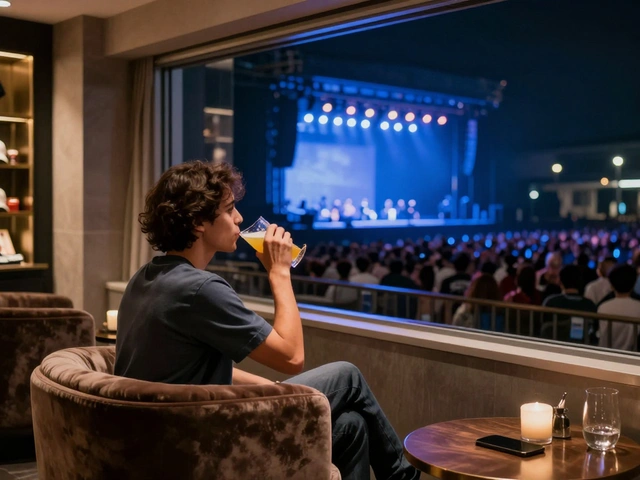

When you stream a live concert online, who actually owns that performance? Is it the band? The venue? The person filming it? Or does the audience? The answer isn’t simple-and if you’re a musician, a streamer, or even a fan sharing clips, you need to know the rules.
A live concert isn’t automatically copyrighted just because it happened. Copyright doesn’t protect the act of performing-it protects the original creative work that’s being performed. That means the song itself, the lyrics, the melody, and the arrangement are copyrighted. But the way the band plays it live? That’s a different story.
Under U.S. copyright law (17 U.S.C. § 102), musical compositions are protected. So if a band plays "Bohemian Rhapsody," the copyright belongs to Queen’s songwriters. But if the drummer adds a new fill, the guitarist improvises a solo, or the singer changes the phrasing-that’s a live interpretation. That version isn’t automatically copyrighted unless it’s fixed in a tangible form, like a recording.
Here’s the key: live performances are protected under performance rights, not copyright. In the U.S., performers have rights under the Sound Recording Act and the Copyright Act’s Section 1101, which gives them control over unauthorized fixation and distribution of their live shows. That means if someone records your concert and uploads it without permission, you can take legal action-even if you didn’t write the songs.
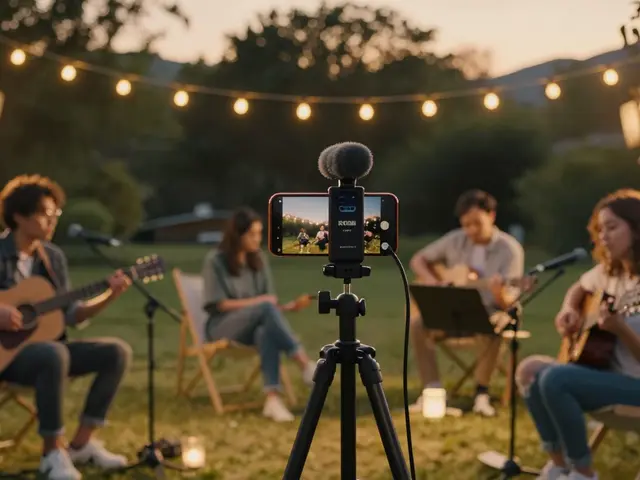
Many artists stream their shows on Instagram, YouTube, or Twitch. But streaming isn’t just sharing a video. It’s distributing a performance that includes copyrighted material. Even if you’re the artist, you can’t legally stream a cover song without a license.
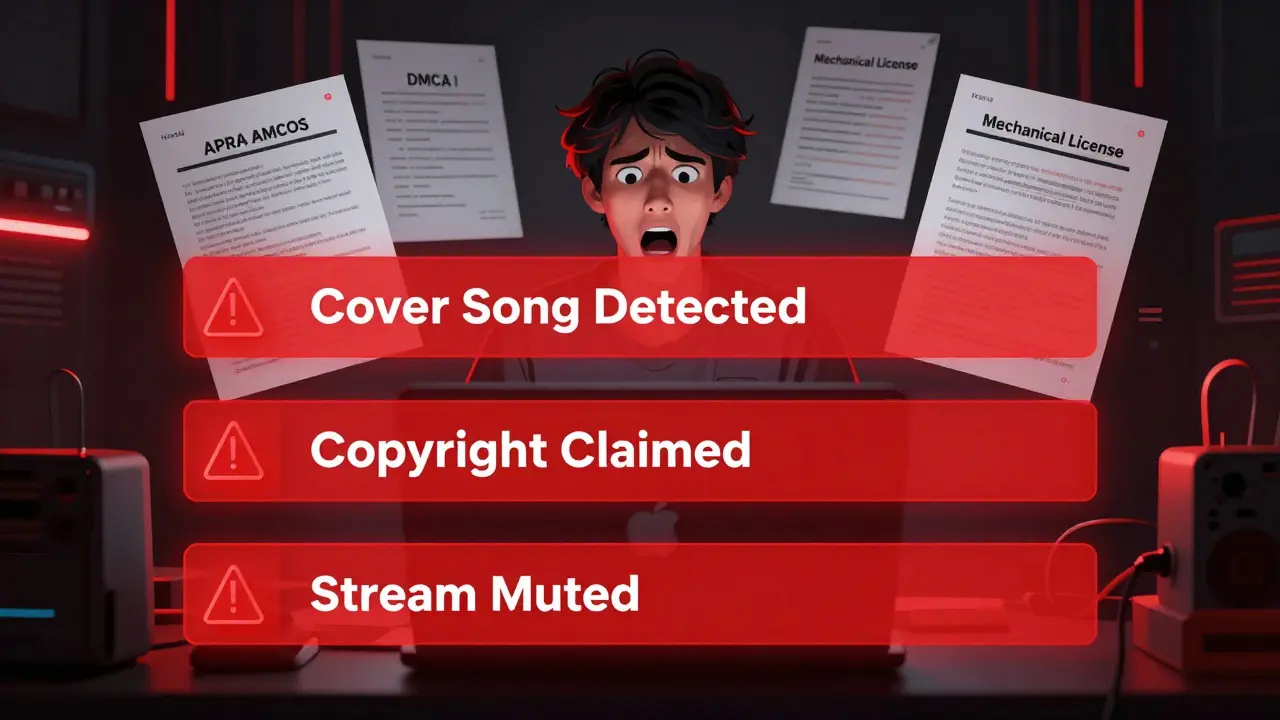
Platforms like YouTube have automated systems that detect copyrighted music. If you stream a live version of a Taylor Swift song, YouTube’s Content ID system may mute your stream, block it, or run ads on it-and the revenue goes to the copyright holder. That’s not a glitch. It’s the law.
For original songs? You’re safer. But you still need permission from the venue, the sound engineers, and sometimes the lighting crew if they contributed creative elements. In New Zealand, the Copyright Act 1994 gives performers exclusive rights to authorize recording and broadcasting of their live performances. That includes digital streaming.
Real example: In 2023, a small indie band in Wellington streamed their gig at The Kings Arms. They played three covers. Within 48 hours, their stream was taken down by YouTube. They didn’t get a warning. No notice. Just gone. They didn’t know they needed a mechanical license for each cover song. That’s how common this mistake is.
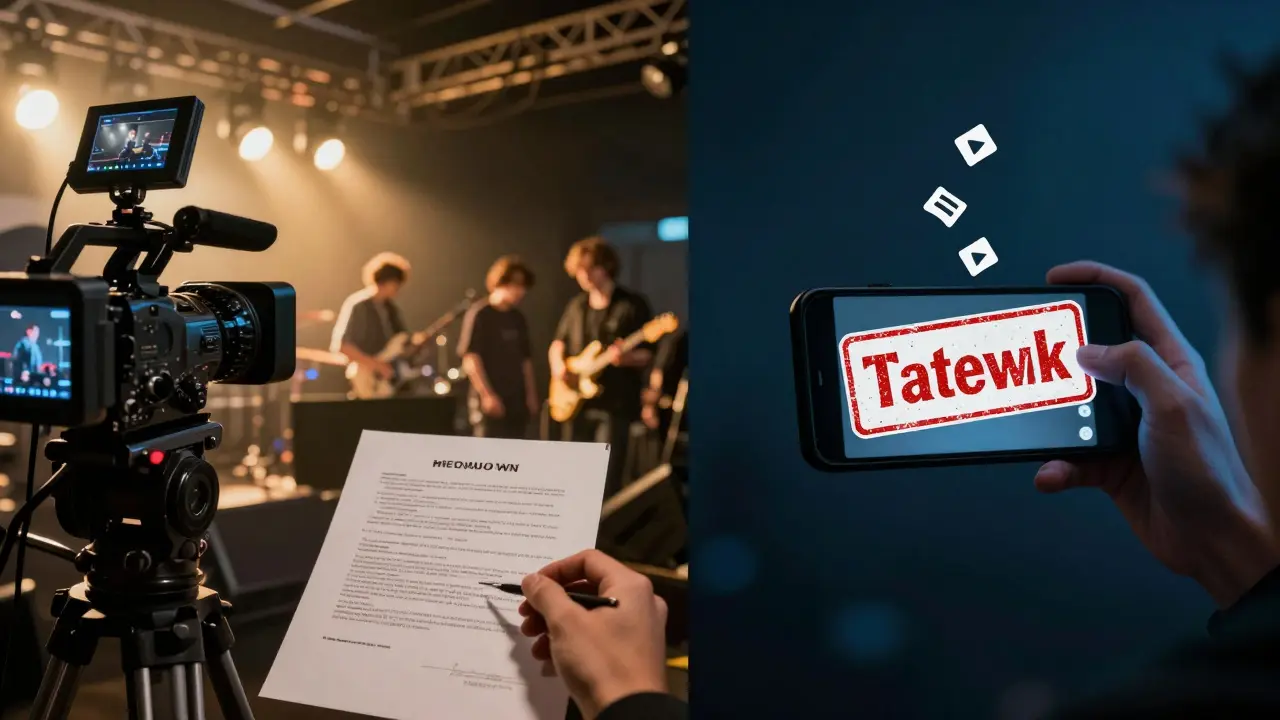
If a fan films your concert on their phone, who owns that video? The fan owns the physical recording-the file on their phone. But they don’t own the performance inside it. You, as the performer, own the rights to the live rendition. The venue may also have rules. Many venues require you to sign agreements that give them rights to record and use footage for promotional purposes.
So if you’re the artist: you control whether that fan’s video can be shared. You can ask them to take it down. You can even sue if it’s used commercially. But if you’re the fan? You can’t legally post it without permission from the performer and the copyright holder of the songs.
There’s one exception: fair use. In the U.S., short clips used for commentary, criticism, or education might qualify. But streaming a full concert? That’s not fair use. It’s distribution. And distribution without permission is infringement.
Big artists like Coldplay or Taylor Swift stream concerts through official channels. How do they do it legally? They have teams of lawyers, licensing agencies, and contracts in place.
They secure:
Even then, they often limit the stream to certain regions or time windows. A global live stream of a concert requires dozens of licenses across different countries. That’s why most small acts don’t stream full concerts-they post 60-second clips.
Most people think the worst that happens is a takedown. That’s not true.
Under the Digital Millennium Copyright Act (DMCA) and similar laws in New Zealand and the EU, you can be sued for statutory damages. In the U.S., that’s $750 to $150,000 per work infringed. If you stream a 10-song set with 3 covers, you could be liable for up to $450,000-even if you didn’t make a cent from it.
Platforms don’t protect you. YouTube won’t pay your legal fees. Instagram won’t defend you in court. You’re on your own.
There’s also reputational damage. Bands get blacklisted by venues. Promoters refuse to book you. Labels drop you. Streaming platforms ban your account. One mistake can end your career.
It’s not impossible. Here’s how to do it right:
There are affordable options. Services like Lickd and Songtradr offer licensed music for streamers for as little as $10 per song. For original music, register your songs with APRA AMCOS or your local equivalent. That way, if someone else streams your music, you get paid.
Most artists don’t go after fans. Why? Because fans are their biggest supporters. But that doesn’t mean it’s legal.
Some bands encourage fan footage. They’ll say: "Feel free to record, just don’t sell it." That’s a policy, not a license. Legally, they’re still violating copyright if they don’t have the rights to the songs.
Some artists, like Phish and the Grateful Dead, have long-standing policies allowing taping. But even they have rules: no professional gear, no commercial use, no uploading full shows. They’ve built their business around this-by selling official recordings, not letting fans do it freely.
If you’re a fan: don’t assume it’s okay. Ask. If you get a yes, get it in writing. If you’re a band: be clear. Put your policy on your website. Don’t leave it to guesswork.
Live streaming is booming. In 2025, over 60% of independent artists in New Zealand and Australia streamed at least one live show. But only 12% had the proper licenses. That’s a ticking time bomb.
Record labels and publishers are getting smarter. They’re using AI to scan platforms for unlicensed streams. Automated systems now detect not just the music, but the tempo, the vocal tone, even the crowd noise to match live performances to registered songs.
If you’re streaming, you’re not just sharing music. You’re handling intellectual property. And that comes with responsibility.
Recording a live concert with your phone isn’t illegal by itself-but sharing it online without permission is. You’re violating the performer’s rights and the copyright holder’s rights to the songs. Even if you don’t monetize it, posting it publicly can lead to takedowns or legal action.
No. Giving credit doesn’t make it legal. You need a mechanical license to reproduce the song and a performance license to broadcast it. Platforms like YouTube may allow it temporarily, but they’ll still claim ad revenue or mute your stream. The copyright holder owns the rights, not you.
If you wrote and recorded the songs yourself, you own the rights. But if you’re performing at a venue, check if they have a blanket performance license with APRA AMCOS or your local collecting society. If not, you may need to get one yourself to legally stream from that location.
You can file a DMCA takedown notice with the platform. You can also contact the fan directly. Many artists choose to ask politely first. But if the video is being used commercially-like on a YouTube channel with ads-you have the right to demand removal and may pursue damages.
Only if you have written permission from the performer and the copyright holders of all songs used. Fair use is very limited here. Documentaries need licenses for music, even if they’re educational or non-profit. Without them, you risk being blocked from distribution platforms like Netflix or Vimeo.
Live music is powerful. But it’s also protected by layers of law. Whether you’re the artist, the fan, or the streamer, ignorance won’t save you. Copyright isn’t about stopping creativity-it’s about making sure creators get paid for their work.
Stream with permission. License what you use. Ask before you post. The music industry isn’t out to get you. But if you ignore the rules, you’ll find yourself on the wrong side of them.
Angelina Jefary
Okay but have you ever noticed how the RIAA secretly owns every crowd noise now? They’re using AI to trace your sneeze during a live show and calling it copyright infringement. I saw a guy get sued because his cough matched the beat of a Taylor Swift song. It’s not paranoia-it’s documented. The government’s got a backdoor in every phone mic. Don’t stream. Don’t breathe near a stage.
Jennifer Kaiser
What’s really being protected here isn’t the music-it’s the system that monetizes it. The artist who wrote the song gets paid. The label gets paid. The platform gets paid. But the person who showed up, felt something, recorded it, and shared it with three friends? They’re the criminal. We’ve turned human connection into a licensing agreement. The law doesn’t care about why you posted it. It only cares who owns the file. That’s not justice. That’s capitalism with a copyright stamp.
TIARA SUKMA UTAMA
so if i record a concert on my phone and post it im a criminal? but if a big label does it its fine? that makes no sense.
Jasmine Oey
OH MY GOD. I just realized-I posted a 45-second clip of my cousin’s band playing ‘Wonderwall’ at a backyard BBQ last summer. I didn’t even know it was a cover. I thought OASIS was public domain?? Like, I’m basically a music pirate now?? I’ve been living a lie. My Instagram is a crime scene. My phone is evidence. I need to delete everything. I’m going to cry. I’m going to jail. I’m going to lose my soul.
Marissa Martin
I don’t think anyone should be sued for sharing music they love. But I also think artists deserve to be paid. It’s just… complicated. I wish there was a middle ground. Maybe we could all just… be nicer about it?
James Winter
Canada doesn’t have this mess. We let people record concerts. If you don’t like it, don’t go. Stop trying to control everything. This is why people hate the US music industry.
Mongezi Mkhwanazi
Let me be perfectly clear-this isn’t about copyright. This is about control. The music industry, since the dawn of the phonograph, has sought to commodify every vibration of human expression. A live performance is ephemeral by nature-its value lies in its transience, its imperfection, its raw humanity. To treat it as intellectual property is to misunderstand the very essence of music. The law, as written, is a blunt instrument wielded by corporations who see not art, but assets. The fan who films a show isn’t stealing-they’re preserving. The artist who denies them that right is denying the soul of performance itself. And yet, the licensing bureaucracy? It’s a labyrinth designed to silence the small, to enrich the already rich. It’s not about fairness. It’s about power. And until we dismantle the myth that creativity must be owned, we’ll keep drowning in legal noise while the music dies.
Tiffany Ho
This is so helpful I didn’t even realize I needed to get a license just to stream my own songs at a coffee shop. I thought if I wrote it I could do whatever. Thanks for clarifying! I’m going to check with APRA right now. Also I’m gonna tell my bandmates about this. We’re all in this together :)
michael Melanson
There’s a big difference between a fan recording a snippet for personal use and a full stream that replaces ticket sales. The law tries to draw that line, but platforms make it messy. Artists need protection. Fans need to feel connected. The system’s broken, but the intent isn’t evil. We just need better tools.
lucia burton
From a music tech compliance standpoint, the real bottleneck isn’t the DMCA-it’s the fragmented licensing ecosystem. Performance rights organizations operate in silos, sync licenses require multi-jurisdictional clearance, and mechanical royalties for digital streams are still governed by 1970s-era statutory rates. Without a unified digital rights infrastructure-think blockchain-based metadata tagging and automated royalty distribution via smart contracts-we’re just band-aiding a systemic collapse. The industry’s clinging to legacy models while creators are already operating in a decentralized, real-time, user-generated ecosystem. The law hasn’t caught up because it’s owned by the same entities that built the old model. Innovation is being stifled by bureaucracy dressed up as protection.
Denise Young
Oh honey. You think this is bad? Wait until the AI starts cloning your vocal runs and selling them as royalty-free loops on Splice. You spent three years perfecting that ad-lib in your live version of ‘Hallelujah’? Congrats-it’s now a $2.99 sample pack in someone’s lo-fi beat. The real crime isn’t the fan posting your show. It’s that your art is being harvested by algorithms before you even get paid. And no, ‘I didn’t know’ doesn’t fly when your voice is in a TikTok trend. You want to stream? Register your songs. Track your rights. Get a lawyer. Or get ready to watch your life’s work become a meme.