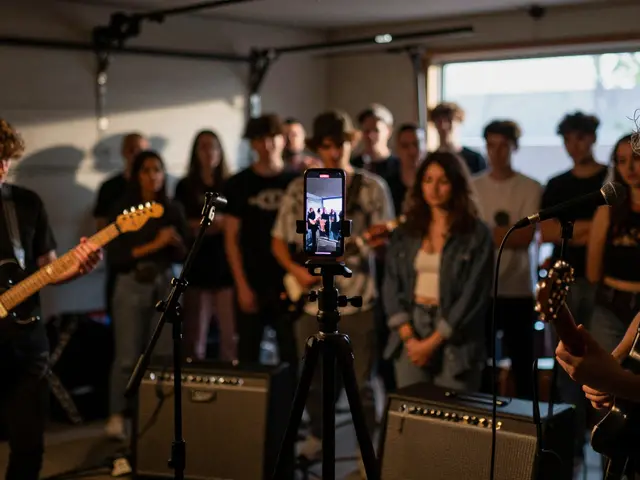

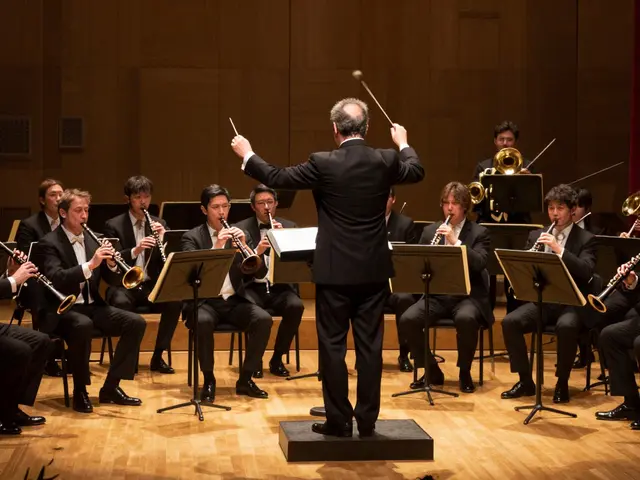
Ever sat through a concert and wondered who’s really in charge when the music starts? It’s not the violinist in the front row, nor the trombonist blowing the loudest note. It’s the person standing in front of the ensemble, arms moving like a painter’s brush across an invisible canvas. That’s the conductor - the heartbeat of a concert band.
A conductor doesn’t play an instrument during the performance. Instead, they lead it. Their job is to unify dozens - sometimes over a hundred - musicians into one cohesive voice. Think of it like a symphony of traffic lights: each player has their own part, but without someone coordinating the timing, rhythm, and emotion, it turns into noise.
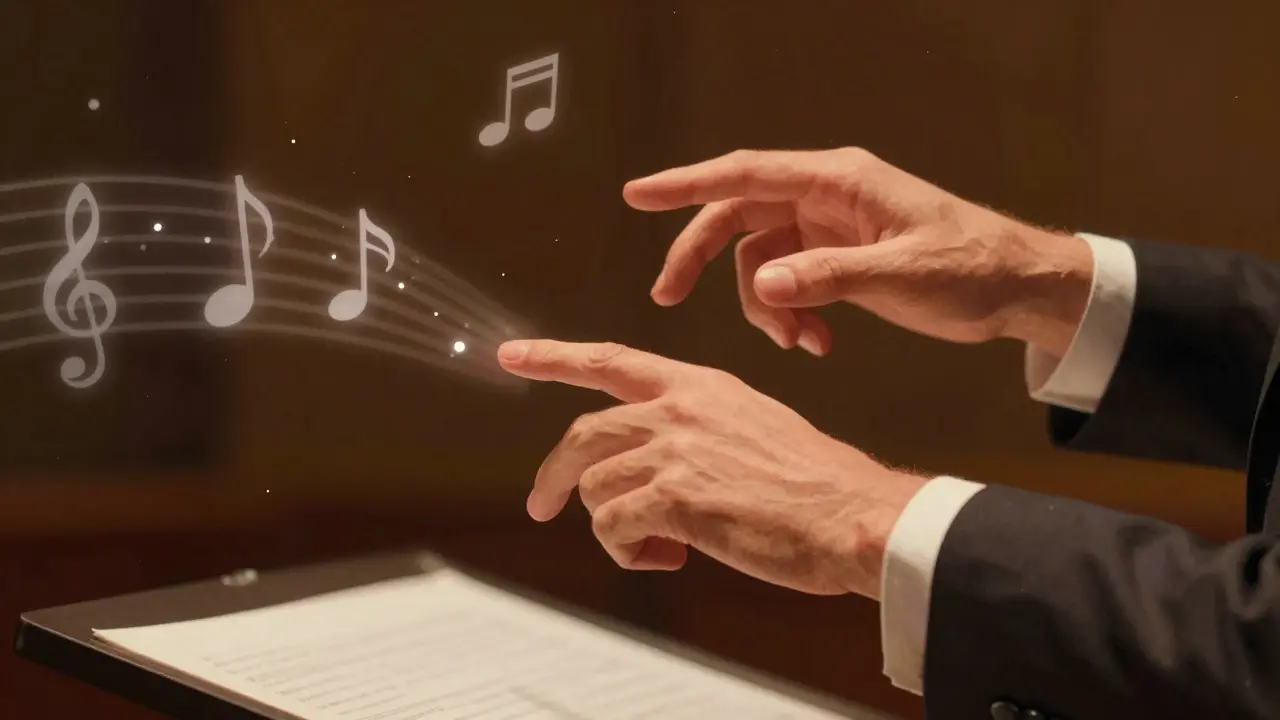
The conductor sets the tempo. Not just with a metronome click, but with subtle shifts in hand motion - a slight pause before a crescendo, a quick flick to signal a staccato, or a slow downward sweep to hold a note longer than written. They interpret the score, deciding how loud a flute should be in measure 47, or whether the timpani should whisper or thunder in the finale.
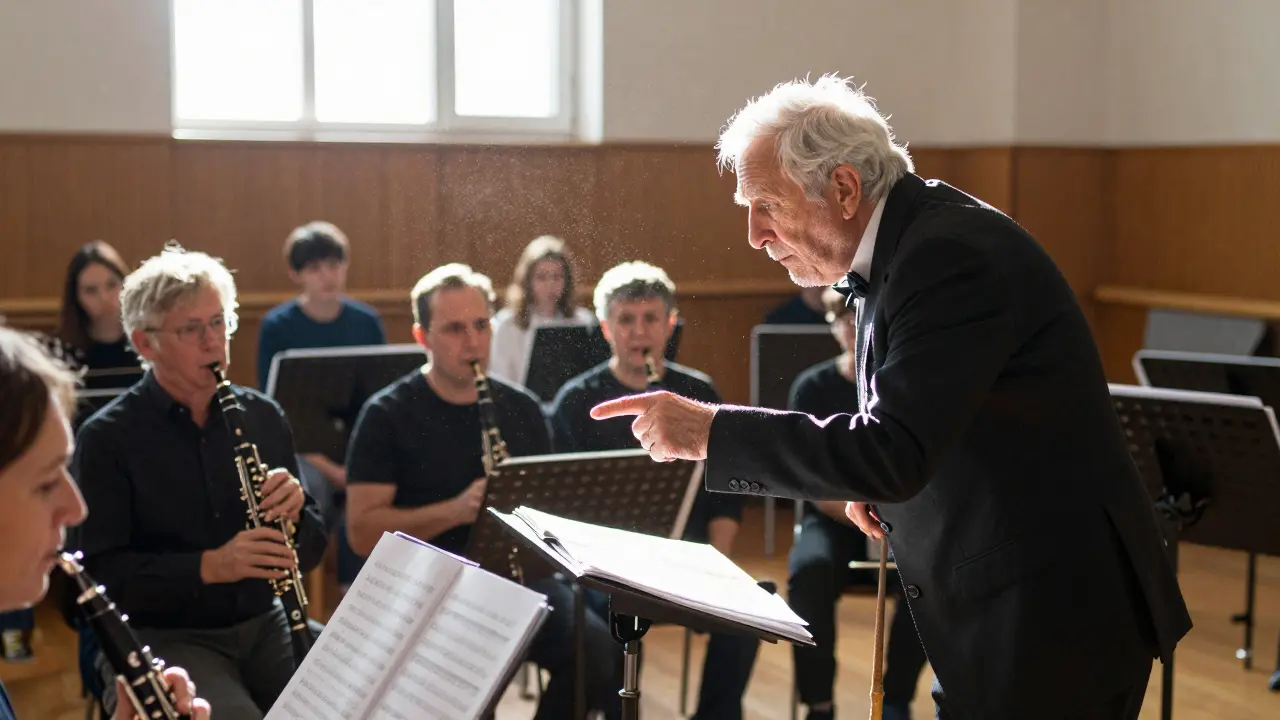
They also cue entrances. A clarinetist might be waiting for a breath, eyes glued to the conductor’s left hand. A timpani roll needs to land exactly as the trumpet hits its high note. One missed cue, and the whole section falls out of sync. Conductor’s eyes don’t just watch - they communicate. A raised eyebrow, a nod, a glance: these are signals more precise than any written instruction.
Most conductors start as musicians. Many played in school bands, then moved on to college ensembles, and eventually studied music performance or conducting at a conservatory. It’s rare to become a conductor without deep experience playing an instrument. You need to understand what it feels like to hold a French horn, breathe through a clarinet reed, or stretch your fingers across a violin fingerboard.
Training isn’t just about technique. It’s about listening. A great conductor can hear if a single oboe is a quarter-tone flat, even over the roar of a full brass section. They train their ears to catch imbalances - when the percussion is too loud, or the woodwinds are buried under strings.
Many conductors spend years as assistant conductors or rehearsal coaches before leading their own ensemble. It’s a slow climb. The New Zealand Symphony Orchestra’s current principal conductor, for example, spent 12 years working under three different maestros before taking the top spot. There’s no shortcut. You learn by watching, by failing, and by listening - constantly.
People often confuse concert band leaders with school band directors. While both lead groups, their roles differ in scope and setting.
A band director usually works in schools or community groups. Their job includes teaching music theory, managing schedules, buying sheet music, organizing uniforms, and even fundraising. They’re part teacher, part administrator, part parent.
A conductor typically leads professional or semi-professional ensembles. Their focus is purely on artistic interpretation. They rehearse for hours, refine phrasing, and shape the sound of a performance - often with a recording contract or live concert season hanging in the balance. They don’t manage logistics. They don’t handle payroll. They focus on the music.
That said, in smaller towns or regional ensembles, one person might wear both hats. In Wellington, for instance, the Capital Wind Orchestra’s leader is also the music educator at a local high school. But in cities like Vienna, Tokyo, or Chicago, the conductor is a dedicated artist - often with a global reputation.
You’ve probably seen videos of string orchestras playing without a conductor. They rely on eye contact, subtle body language, and years of playing together. But wind bands? They’re a different beast.
Concert bands include dozens of instruments that don’t exist in orchestras: saxophones, euphoniums, sousaphones, piccolos, and multiple percussion setups. These instruments often play complex, layered parts that change rhythm or dynamics on the fly. There’s no single leader among them.
Without a conductor, timing falls apart. A snare drum might rush because the clarinets are dragging. A tuba might enter too early because the trumpet section hesitated. The conductor is the only person who sees the whole picture - every section, every measure, every breath.
Even in professional ensembles that rarely use a conductor (like some jazz groups or small chamber orchestras), the concert band needs one. The sheer size, the number of instrument families, and the complexity of modern compositions make it impossible to coordinate without a central figure.
Some of the most famous conductors in concert band history didn’t start with a baton. Frederick Fennell, who founded the Eastman Wind Ensemble in 1952, revolutionized how wind music was performed. He insisted on precision, balance, and expressive phrasing - ideas that became standard worldwide.
Jerry Junkin, conductor of the University of Texas Wind Ensemble, is known for commissioning over 100 new works for wind band. He didn’t just play the music - he expanded what the band could do.
And then there are the unsung heroes: regional conductors who spend 40 years shaping young musicians, rehearsing every Tuesday night, and never seeing their names in the papers. In New Zealand, conductors like John Hopkins of the Auckland Wind Symphony have led ensembles for over three decades, turning amateur players into skilled musicians through patience and passion.
It happens. A conductor gets the flu. A flight gets canceled. A family emergency arises. What then?
The assistant conductor steps in - if there is one. If not, the most experienced musician in the ensemble, often the principal clarinetist or percussionist, takes charge. They’ll lead from their seat, using gestures and eye contact to guide the group. It’s messy. It’s imperfect. But it works.
Still, nothing replaces the conductor. A band can play the notes without them. But only with them can it truly sing.
Some wonder if technology will replace the conductor. AI can analyze scores. Robots can keep time. Why not let algorithms lead?
But music isn’t just timing. It’s emotion. It’s breath. It’s the quiet moment between notes where a musician decides to hold back - because they feel something deeper than the score says.
Conductors don’t just count beats. They interpret human feeling. They know when to let a note linger because the audience is holding its breath. They sense when a player is tired, and adjust the volume to carry them through. No algorithm can read that.
As long as people gather to make music together - not just play it - there will be someone standing in front, baton in hand, heart in tune with every note.
Yes, but only in very small ensembles or highly rehearsed groups, like some chamber orchestras. Concert bands - with their size, complexity, and variety of instruments - almost always need a conductor to maintain timing, balance, and expression. Without one, sections often drift out of sync, especially in fast or dynamic passages.
No, but most have deep experience playing at least one instrument - often woodwind, brass, or percussion. Understanding how an instrument works helps them communicate better with players. A conductor who’s played the French horn knows exactly what breath support feels like and can guide players more effectively than someone who’s never held one.
Not at all. Many conductors, especially in Europe and Asia, use only their hands. The baton is just a tool to make movements more visible, especially in large halls. Some conductors find it distracting. Others refuse to use one because they believe their hands convey more nuance. What matters isn’t the baton - it’s the clarity of the gesture.
They don’t memorize every note like a pianist. Instead, they internalize the structure: form, key changes, dynamics, and cues. They know where each section enters, how long rests last, and how the music builds. Many use annotated scores with color-coded markings and notes. Rehearsals reinforce this knowledge. It’s less about memorization and more about deep understanding.
In professional ensembles, yes - but not always by much. A principal conductor of a major symphony orchestra might earn $200,000-$500,000 a year, while a lead violinist might make $150,000. In community bands, conductors are often volunteers or paid modest stipends. Pay depends on the ensemble’s budget, location, and prestige - not just the role.


Paul Timms
Conductors don’t just wave their arms. They listen harder than anyone in the room. I’ve played in bands where the conductor caught a single out-of-tune note in measure 112 and fixed it before the next phrase. That’s not magic. That’s years of training.
And no, you don’t need to play every instrument-but you damn well need to understand how each one breathes.
Jeroen Post
They say the conductor leads but really the music leads itself. The score is alive. The conductor just pretends to control it. It’s all theater. The real power is in the notes-they don’t need a human to tell them when to breathe.
AI could do this better. No ego. No fatigue. Just pure mathematical phrasing. Why waste a person on this?
Nathaniel Petrovick
Man I remember my high school band director just yelling ‘Faster!’ and waving his hands like he was swatting flies. We sounded like a train wreck. Then we got a real conductor in for a guest workshop-suddenly everything clicked. It wasn’t about being loud. It was about being together.
Still don’t know how he did it. But I’ll never forget it.
Sally McElroy
It’s infuriating how people romanticize conductors like they’re some kind of musical priest. The truth? Most are overpaid egoists who never lifted a trumpet in their life. They sit there like gods while the musicians sweat through rehearsals, fix their own intonation, and clean up the messes their ‘interpretation’ creates.
And don’t get me started on the baton-it’s a prop. A ridiculous, unnecessary prop for people who can’t communicate without a stick.
Destiny Brumbaugh
USA got the best conductors. No contest. Vienna? Pfft. Tokyo? Cute. You think they know how to make a band really sing? Nah. We’ve got Junkin. We’ve got Fennell. We built the modern wind band from the ground up. If you’re not playing American-style wind music, you’re not playing music-you’re just practicing.
Sara Escanciano
Anyone who thinks a band can function without a conductor is delusional. It’s not about tradition-it’s about physics. Human beings don’t naturally sync up. You need a leader. You need authority. You need someone who won’t let chaos win.
And if you think a clarinetist can lead a 120-piece ensemble? That’s not leadership. That’s a disaster waiting to happen.
Elmer Burgos
I used to think conductors were just fancy metronomes. Then I saw one cue a bassoon entry with a single blink. The whole section locked in like it was wired to their brain.
It’s not about control. It’s about trust. The musicians aren’t following a baton-they’re following a feeling. And that’s something no robot or algorithm will ever get.
Jason Townsend
Conductors are just the tip of the iceberg. The real power is in the rehearsal assistants, the score annotators, the librarians who hand out the right pages. Nobody talks about them. But if one of them messes up, the whole concert collapses.
The conductor gets the applause. The crew gets the silence. That’s the system.
Kirk Doherty
I’ve seen a conductor cry after a performance because a young tuba player nailed their solo. Not because it was perfect. But because they’d been trying for three years. That’s the thing no one talks about. It’s not about the music. It’s about the people.
Kelley Nelson
While the article presents a compelling narrative regarding the conductor's indispensable function within the concert band, it remains fundamentally reductive in its anthropocentric framing. One must consider the ontological primacy of the musical text itself-the score as autonomous agent, unmediated by human volition. The conductor, in this paradigm, is not a leader but a hermeneutic intermediary, a performative veil obscuring the score’s intrinsic teleology.
Moreover, the glorification of individual conductors such as Fennell and Junkin betrays a romantic fallacy: the cult of the maestro. In a truly enlightened musical society, ensemble cohesion would emerge through algorithmic synchronicity, calibrated by machine learning models trained on centuries of acoustic data. Human conductors are, at best, a transitional artifact.