
If you streamed a live concert and hit 1 million views, you might be imagining a fat bank deposit. But here’s the truth: 1 million views on YouTube doesn’t mean $1 million. Not even close. For most independent artists and small labels, that milestone might bring in between $2,000 and $10,000 - and that’s if everything lines up perfectly.
YouTube doesn’t pay per view. It pays based on ad revenue, and that’s where things get messy. The platform doesn’t hand you cash for every person who clicks play. Instead, it tracks how many ads were shown, how long viewers watched them, and whether they skipped or clicked. That’s what determines your payout.
When you stream a live concert on YouTube, the money comes from ads placed before, during, or after the stream. YouTube uses something called CPM - cost per mille - which means cost per thousand impressions. That’s not the same as views. An impression is when an ad actually loads on someone’s screen. If someone skips the ad in 2 seconds, you get almost nothing. If they watch 30 seconds of it? You earn more.
For live concert streams, CPMs vary wildly. In 2026, the average CPM for music content on YouTube sits between $2 and $10. That means for every 1,000 ad impressions, you earn $2 to $10. But here’s the catch: not every viewer triggers an ad impression. Some use ad blockers. Others watch on mobile without ads enabled. Some are in countries where advertisers pay less - like India or Indonesia - where CPMs can drop below $0.50.
So if you hit 1 million views, you might only get 300,000 to 600,000 actual ad impressions. Multiply that by a CPM of $3, and you’re looking at $900 to $1,800. That’s before YouTube takes its 45% cut. After YouTube’s share, you’re left with $495 to $990.
Not all 1 million views are created equal. A stream from a fan in Germany or the U.S. is worth more than one from a fan in Brazil or Vietnam. Advertisers pay more to reach audiences in wealthier countries. If 70% of your 1 million viewers are from North America or Western Europe, your CPM could jump to $7 or $8. That could push your earnings toward $5,000-$8,000 after YouTube’s cut.
But if your concert stream is mostly viewed in Southeast Asia or Africa, your CPM might stay under $1.50. Even with 1 million views, you could end up with less than $500.
There’s another factor: watch time. YouTube rewards longer sessions. If viewers stay for the whole 90-minute concert, the platform shows more ads - sometimes up to three mid-roll ads. If they bounce after 5 minutes? You get one ad impression. That’s why high-energy, full-length streams from popular bands often earn more than short clips or fan-recorded snippets.
Ad revenue isn’t the only way you make money from a live stream. Super Chats - those highlighted, paid messages viewers send during the stream - can add thousands in real time. A major artist with a loyal fanbase can pull in $5,000 to $20,000 in Super Chats during a single concert stream. That’s often more than the ad revenue.
YouTube Memberships also help. If your channel has 10,000 subscribers and 5% of them pay $4.99/month to join, that’s $2,500 a month in recurring income. One big stream can convert hundreds of casual viewers into paying members. That’s a long-term win.
Merch drops during the stream? If you sell 1,000 T-shirts at $25 each? That’s $25,000. That’s the real money maker - not YouTube’s ad payout. Many artists now treat YouTube streams as free advertising, not direct income.
You can’t control where your viewers are from. But you can control how you structure the stream. Here’s what works:
Also, make sure your channel is monetized. Many independent artists forget to enable ads on live streams. Or they’re in a country where YouTube doesn’t allow monetization for music content. Check your YouTube Studio dashboard. If it says “Not eligible for ads,” you’re not earning anything.
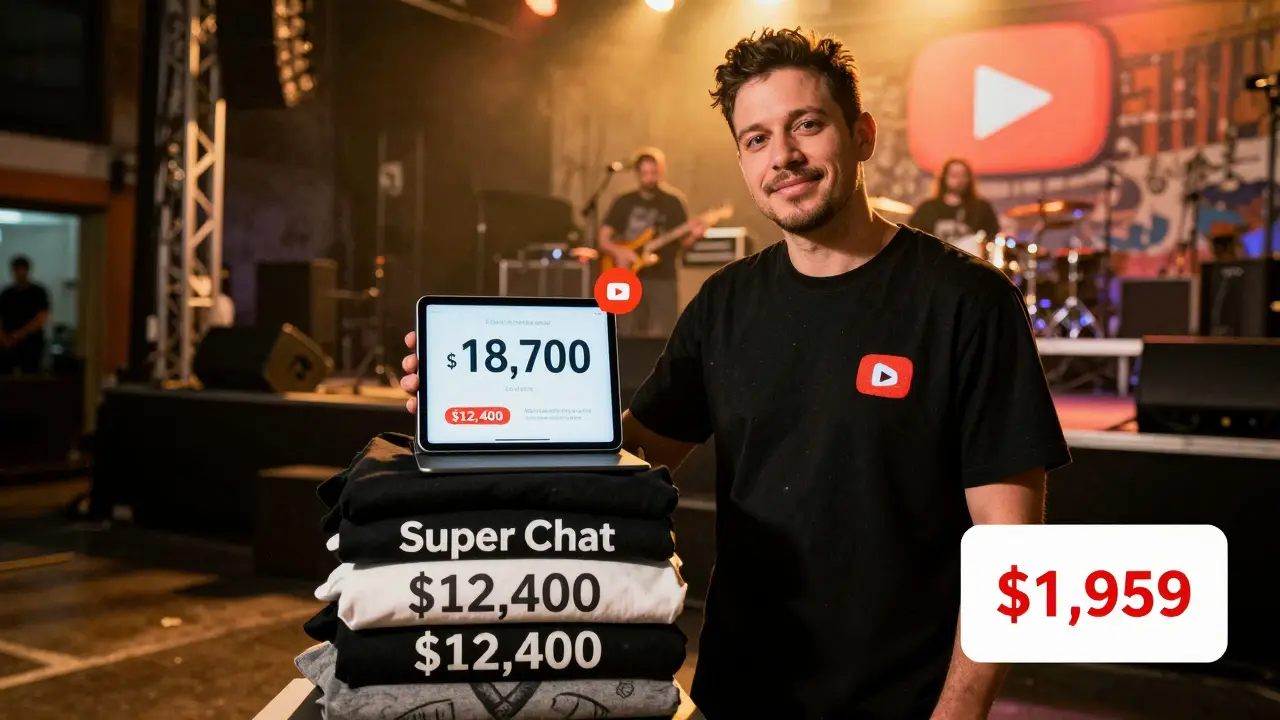
Last year, indie rock band The Hollow Hours streamed their album release concert. They got 1.2 million views over 3 weeks. Here’s what they actually earned:
Total direct earnings from the stream: over $33,000. But only $1,959 came from YouTube ads. The rest? Fan support.
Don’t chase 1 million views hoping for a windfall. That’s not how YouTube works anymore. If you’re an artist, treat your live stream like a concert ticket - not a paycheck. Use it to build your audience, collect emails, sell merch, and turn viewers into fans who pay you directly.
The money isn’t in the views. It’s in the connection. The fans who stay, comment, donate, and buy. The ad revenue? That’s just the bonus.
No. YouTube doesn’t pay per view. You earn money when ads are shown and watched. A view doesn’t guarantee an ad impression - many viewers skip ads, use blockers, or watch from regions with low advertiser demand.
It varies widely. For most artists, earnings range from $2,000 to $10,000 total - but only $500 to $2,000 comes from YouTube ads. The rest usually comes from Super Chats, merch sales, and memberships. Location of viewers, watch time, and ad quality matter more than view count.
It’s about audience geography and engagement. Viewers from the U.S., Canada, Germany, or Australia generate higher ad revenue than those from India, Brazil, or Indonesia. Also, streams with longer watch times get more ad slots. Fans who stay for the full concert and interact (Super Chats, comments) help boost earnings.
Not if you’re relying on ad revenue. Platforms like Twitch or Patreon often pay better for live streams because fans pay directly. YouTube is great for exposure, but you’ll make more money by directing viewers to your merch store, Bandcamp, or ticket page than by waiting for YouTube ads.
No. You need to be part of YouTube’s Partner Program (1,000 subscribers and 4,000 watch hours in the past year) to earn ad revenue. Even then, live streams must be enabled for monetization in YouTube Studio. If you’re not approved, you won’t get any ad money - even with millions of views.

Frank Piccolo
Let me get this straight - you think a million views equals money? Bro, YouTube is a goddamn ad farm. I’ve seen bands with 5M views clear less than $800 because their audience is 80% from Bangladesh where advertisers pay in digital confetti. You’re not a musician - you’re a content cattle.
And don’t even get me started on ‘Super Chats.’ That’s just begging with emojis. If your fans have to pay $5 to say ‘I love you,’ you’re already dead as an artist.
Real talk: if you’re relying on YouTube to pay your rent, go get a job at Walmart. At least they give you health insurance.
Also - who the hell streams a concert and doesn’t monetize it? That’s like opening a bar and refusing to sell beer.
James Boggs
Thank you for this detailed breakdown. It’s refreshing to see such a clear, evidence-based analysis of YouTube monetization. Many creators misunderstand the mechanics, assuming view count directly correlates to revenue. Your emphasis on CPM, viewer geography, and watch time is spot-on.
I particularly appreciate the note about enabling monetization in YouTube Studio - it’s a common oversight. Your structured recommendations for optimizing streams are practical and actionable. Well done.
Addison Smart
I’ve been streaming live concerts for five years now - from basements in Portland to sold-out shows in Berlin - and this post nails something deeper than dollars.
Yes, the math is brutal. A million views from Jakarta? You’re looking at $120. But here’s the thing - that one fan in Jakarta who stayed for the whole set, sent a Super Chat, and then bought your vinyl on Bandcamp? They’re now part of your tribe. That’s the real metric.
YouTube isn’t a bank. It’s a global radio station that broadcasts your soul. The money? That comes later - from the people who feel seen.
I’ve had fans from Nigeria message me saying, ‘I played your album during my sister’s funeral.’ That doesn’t show up in analytics. But it’s why I keep doing this.
Don’t chase views. Chase connection. The ads? They’re just the background noise. The silence between the notes? That’s where the magic lives.
Also - if you’re not linking to merch or Patreon? You’re leaving your future on the table. Don’t be afraid to ask. Fans want to support you. They just need a way to do it.
And yes - tell them to disable ad blockers. It’s not greedy. It’s survival. You’re not a corporation. You’re a person with a guitar and a dream. They owe you that much.
David Smith
Oh wow. So after all this, you’re saying the guy who spent 10 hours editing his live stream, paid for the lighting, hired the sound engineer, and drove 300 miles to play in front of 200 people gets $1,900… while some guy in India uploads a 10-minute TikTok cover of ‘Bohemian Rhapsody’ and makes $12,000 from ads?
That’s not capitalism. That’s a joke. A cruel, algorithmic joke.
And don’t even get me started on ‘Super Chats.’ So now I’m supposed to beg for money like a street performer? ‘Hey guys, I’m tired, I’m broke, and I played ‘Stairway’ for 12 minutes - can you spare $7?’
This system is rigged. It rewards hype, not art. And YouTube? They’re laughing all the way to the bank while we play for free in front of 1.2 million people who never once clicked ‘buy.’
Someone needs to burn this platform down.
Lissa Veldhuis
Okay but have you ever actually watched a live stream where the audio is just a phone recording and the camera is pointing at a ceiling fan while someone sings ‘I Will Survive’ in a hoodie?
And then they get 800k views and think they’re a star?
NO. NO. NO.
You don’t get paid for views you get paid for VALUE and if your stream looks like a Zoom call from 2020 then you deserve NOTHING not even a single cent not even if your mom watches it 17 times and leaves a heart emoji
Also if you think merch is the answer then why are you still on YouTube why not just go sell shirts at a flea market you’re not an artist you’re a scammer with a mic
and why is everyone acting like this is news like we didn’t know YouTube is a graveyard for dreams
also your band name is The Hollow Hours??? that’s not a band that’s a cry for help
Michael Jones
Here’s the truth nobody wants to say - the music industry died years ago and YouTube didn’t kill it - we did.
We stopped going to shows. We stopped buying records. We stopped caring about the person behind the music.
Now we want a million views and a million dollars like it’s a lottery ticket.
But the real magic? That’s in the 17-year-old kid in Ohio who stayed up until 3 a.m. listening to your set, wrote you a letter, and said you saved his life.
That’s not in the analytics.
That’s not monetizable.
But it’s real.
So stop counting dollars and start counting hearts.
And if you’re still here - still playing - still streaming - you’re already winning.
The system wants you to quit.
Don’t let it.
allison berroteran
I’ve been following independent artists for over a decade now - from Bandcamp to Patreon to live streams - and this post is one of the most honest I’ve read.
The disconnect between perception and reality is staggering. Most creators think a viral stream = financial freedom. But the data shows something quieter, more human: loyalty.
That 820 new members who signed up after The Hollow Hours’ stream? That’s not a number - that’s a community. That’s people who’ll show up next time. That’s someone who’ll buy your next album before it’s recorded.
And yes - the CPMs are brutal. A viewer in Canada pays 12x more than one in Vietnam. That’s not fair. But it’s real.
What I love about this breakdown is how it shifts the focus from passive income to active relationship-building.
YouTube isn’t the destination. It’s the doorway.
And the people who walk through it? Those are the ones who matter.
Thank you for reminding us that art isn’t a spreadsheet.
It’s a conversation.
Gabby Love
Small correction: YouTube’s cut is 45%, so the creator keeps 55%. The example says ‘YouTube’s cut: $1,599’ and ‘net ad revenue: $1,959’ - that math checks out (720k impressions × $4.10 = $2,952; 55% of that is $1,623.60 - close enough, rounding difference).
Also, worth noting: Super Chats are 70% to creator, 30% to Google. Merch sales are 100% yours if you handle fulfillment.
And yes - always enable monetization on live streams. Many forget it’s a toggle in YouTube Studio under ‘Monetization’ settings. No auto-enable.
Good post. Clear, accurate, and needed.