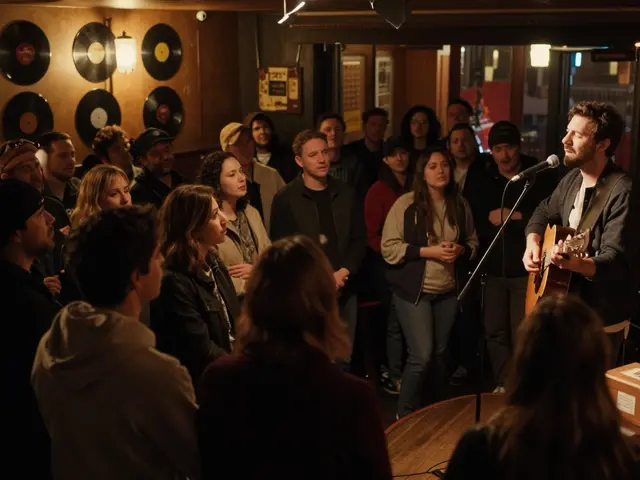

The biggest concerts in history aren’t just loud-they’re cultural events that pull in millions of people. These aren’t festival lineups or one-off shows. These are single performances or single tours that broke records for crowd size, often in open-air venues with no seating limits. If you’ve ever stood shoulder-to-shoulder at a summer show, you know how powerful that kind of energy is. But nothing compares to the scale of the top 10 most attended concerts ever recorded.
Over 3.5 million people showed up on New Year’s Eve 1994 to watch Rod Stewart perform on Copacabana Beach. No tickets were sold. No barriers held back the crowd. The Brazilian government estimated the number based on aerial photos and crowd density models. It’s still the largest concert attendance ever recorded. Stewart played a 90-minute set of classics like "Maggie May" and "Da Ya Think I’m Sexy?" while fireworks lit up the sky. The city’s infrastructure barely held up-traffic jams lasted for days, and emergency services were stretched thin. But for those there, it wasn’t just a concert. It was a national moment.
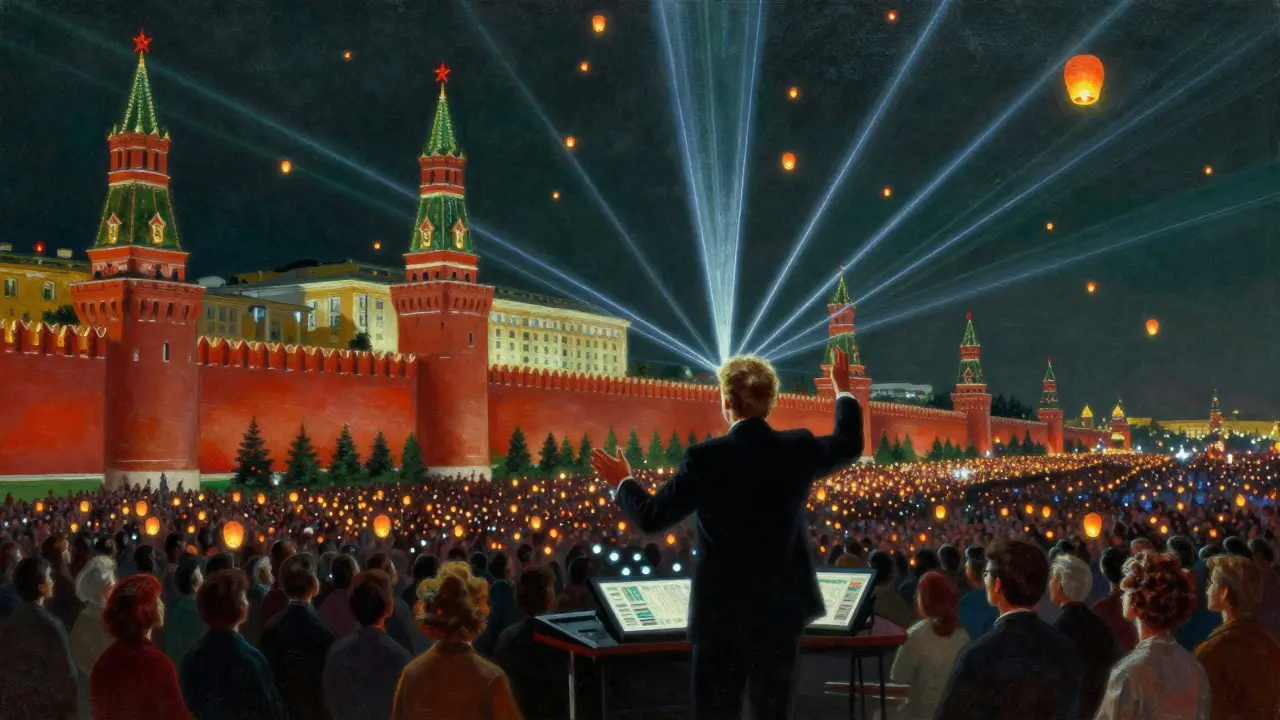
In September 1997, French electronic pioneer Jean-Michel Jarre staged a free concert to celebrate Moscow’s 850th anniversary. Official numbers put the crowd at 3.5 million, with some estimates reaching 5 million. The show featured massive light displays, laser projections on the Kremlin walls, and a 40-minute fireworks finale. Jarre used custom-built synthesizers and a 120-piece orchestra. The event was broadcast live across Russia and parts of Europe. What made it unforgettable wasn’t just the size-it was the symbolism. A Western artist playing to a post-Soviet crowd, using music as a bridge.
Celine Dion drew 1.8 million people to Copacabana for a free concert in 2008. It was part of a promotional tour for her album Taking Chances. The event was organized by a major Brazilian telecom company, and attendees received free SIM cards in exchange for showing up. The crowd stretched from the shoreline to Avenida Atlântica, blocking multiple city blocks. Dion sang hits like "My Heart Will Go On" and "Because You Loved Me" while rain fell lightly overhead. No one left early. The atmosphere was electric, even as security teams struggled to keep the crowd from surging forward.
Paul McCartney played a free concert on Copacabana Beach in 2006, drawing an estimated 1.5 million people. It was his first show in Brazil in over 20 years. He opened with "Yesterday" and closed with "Hey Jude," with the entire crowd singing along. The city shut down roads for miles around. Police helicopters hovered overhead. McCartney wore a white suit and played a 1964 Hofner bass. He didn’t just perform-he connected. At one point, he stopped the music to say, "I’ve played for kings and queens. But this? This is the real royalty."
Just weeks before McCartney’s show, U2 played a free concert at the same beach, pulling in 1.5 million people. The band was promoting their album No Line on the Horizon and had just finished a global tour. Bono wore a red jacket and carried a flag that read "Peace." The concert featured a massive LED screen showing footage of war zones and refugee camps. "Where the Streets Have No Name" was performed with the crowd holding up phone lights like stars. The band later said it was the most emotional show they’d ever played.
Garth Brooks drew an estimated 950,000 people to Central Park in 1997 for a free concert. It was the largest crowd ever for a solo artist in the U.S. The event was broadcast live on HBO. Brooks played for nearly three hours, singing hits like "Friends in Low Places" and "The Dance." He brought out surprise guests like Trisha Yearwood and Billy Joel. The New York Police Department estimated the crowd using drone footage and heat sensors. Traffic in Manhattan ground to a halt. People sat on rooftops, climbed trees, and packed the reservoir. Brooks later said, "I didn’t know that many people even liked country music."
Pink Floyd’s 1990 concert at the Potsdamer Platz in Berlin was held to celebrate the fall of the Berlin Wall. An estimated 200,000 people showed up in person, with over 100 million watching on TV worldwide. The band performed their entire The Wall album live for the first and only time. A 40-foot wall was built on stage and torn down during "The Trial." The concert ended with a massive fireworks display over the Brandenburg Gate. It was more than a show-it was a political statement. Roger Waters, who led the project, said, "This is what music can do when it’s not afraid to be loud."
Elton John played a free concert in São Paulo in 1995 that drew 1.3 million people. It was part of his The One tour. The venue was a massive stretch of land near the Ponte 400 highway. The crowd was so dense that emergency crews had to treat heat exhaustion cases for over 800 people. John wore a glittering silver suit and played piano for nearly two hours. He sang "Rocket Man," "Tiny Dancer," and "I’m Still Standing." The Brazilian media called it "the day the whole city stopped moving."
At the Tushino Airfield in Moscow in 1991, Metallica played to an estimated 1.6 million fans. It was part of a massive rock festival that also featured AC/DC and The Black Crowes. The concert happened just after the Soviet Union collapsed. Many attendees had never seen a live rock show before. Metallica’s set included "Enter Sandman," "Master of Puppets," and "One." The crowd sang along even though most didn’t know the lyrics. The band later said the energy was unlike anything they’d felt before. The air was thick with dust from the crowd’s movement. Security didn’t have enough radios. No one got hurt.
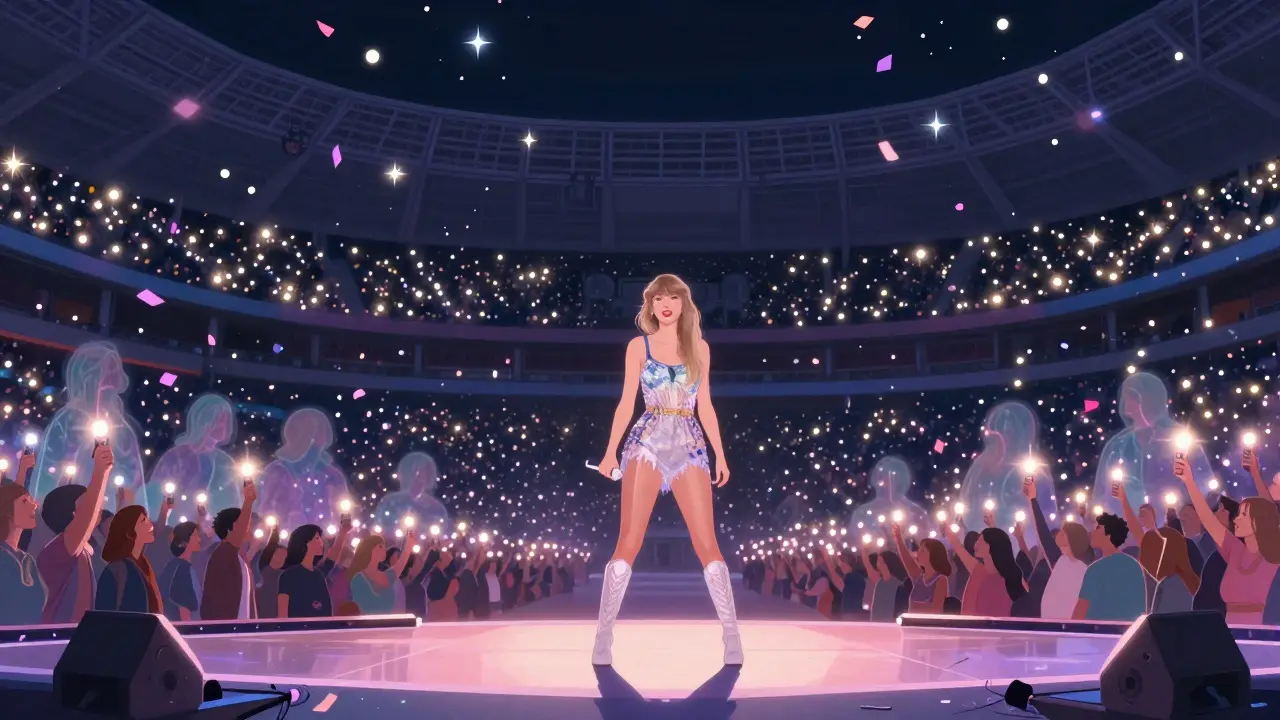
Taylor Swift’s Eras Tour set a new record for the highest-grossing tour in history, but its single biggest crowd came in Chicago in 2023, where 110,000 fans packed Soldier Field over two nights. It wasn’t the largest crowd ever, but it was the largest for a solo female artist in the U.S. in modern times. The stage had 12 moving platforms, 1,200 costume changes, and a 15-minute confetti storm during "Shake It Off." Fans traveled from 47 states and 19 countries. One woman flew in from New Zealand just to be there. Swift later posted a video of herself crying backstage, saying, "I didn’t know love could feel this loud."
It’s not just the artist. It’s timing, location, and access. Most of these events were free. That removed the biggest barrier: money. Many happened in cities with open spaces-beaches, parks, airfields-where crowds could spread out. And they often coincided with major cultural moments: the fall of the Berlin Wall, Brazil’s economic boom, the end of Soviet control. Music became a shared language in times of change.
Modern concerts are different. Ticket prices have soared. Streaming has changed how we discover music. But the desire to be part of something huge hasn’t faded. When a crowd of a million people sings one song together, it’s not just noise. It’s history in real time.
Will any artist ever top 3.5 million again? Maybe. But it would take more than talent. It would take a perfect storm: a global moment, a free show, and a city willing to shut down for a single night. Until then, these 10 concerts stand as monuments-not just to music, but to what people can do when they come together.
The largest concert ever attended was Rod Stewart’s free performance on Copacabana Beach in Rio de Janeiro on New Year’s Eve 1994. An estimated 3.5 million people showed up, making it the highest attendance ever recorded for a single concert. No tickets were sold, and the crowd was measured using aerial photography and density models by Brazilian authorities.
Most of the top 10 concerts were free, which helped them reach such massive numbers. The only exception is Taylor Swift’s 2023 Chicago show, which was ticketed. However, even that event sold out in minutes and required special permits due to its scale. Today, most large-scale concerts use ticketing systems, making it nearly impossible to reach the crowd sizes of the 1990s and early 2000s.
Modern concerts are smaller because of ticket pricing, venue regulations, and safety concerns. In the 90s, many big shows were free, sponsored by brands or governments. Today, most events are commercial, with limited capacity due to permits, security protocols, and infrastructure limits. Also, streaming has fragmented audiences-people don’t all gather for one big event the way they used to.
Rod Stewart, Paul McCartney, and U2 each have one entry on the list. However, if you count solo artists across multiple events, Paul McCartney has the most appearances in the top 10 with two major events: one in Rio in 2006 and another in Central Park in 2003 (which drew 500,000 but didn’t make the top 10). No single artist holds more than one spot in the top 10.
Yes. The 1994 Rod Stewart concert in Rio left behind tons of trash, damaged beachside infrastructure, and caused traffic disruptions for days. The 1997 Jean-Michel Jarre concert in Moscow required months of cleanup after the event. But most cities saw long-term benefits-boosted tourism, global exposure, and renewed public interest in live music. In many cases, the damage was temporary, and the cultural impact lasted decades.


Ronak Khandelwal
This is why music is magic 🌟 Imagine 3.5 million people all breathing the same rhythm, crying at the same note, dancing like no one’s watching-even though literally everyone is watching. We forget how powerful unity feels until we see it like this. No tickets, no barriers, just humanity. We need more of this.
Jeff Napier
3.5 million? Yeah right. That’s just the number the government gave to look good. Most of those people were just stuck in traffic and gave up. And don’t even get me started on the ‘aerial photos’-those things are manipulated. Someone’s selling something. Always is.
Sibusiso Ernest Masilela
How quaint. A rock star on a beach. Pathetic. Real art doesn’t need a crowd of peasants to validate it. Jarre’s symphony was intellectual. Stewart? He was a pub singer with a bad haircut and a sponsorship deal. This isn’t culture-it’s spectacle for the masses who can’t tell a chord from a cough.
Daniel Kennedy
I’ve been to a few big shows, but nothing like this. What’s wild is how these events weren’t about profit-they were about connection. No one’s doing that anymore. Ticket prices are insane, venues are tiny, and everyone’s glued to their phones. We lost something when we stopped letting music be free. We need to bring that back.
Taylor Hayes
I think what’s most beautiful here is how these concerts happened in moments of change-after the Wall fell, after Soviet control ended, during Brazil’s rise. Music became the glue. People didn’t need words. They just needed to be there, together. That’s the real legacy-not the numbers, but the feeling.
Sanjay Mittal
Fun fact: The 1991 Metallica show in Moscow had a crowd so dense that the ground actually compacted. Engineers later measured a 2-inch reduction in soil elevation from the pressure. Also, the band’s PA system was so loud it temporarily disrupted satellite signals in Eastern Europe. Not many know that.
Mike Zhong
The real question isn’t who played to the biggest crowd. It’s why we romanticize these events as if they’re timeless. They’re anomalies. One-time miracles fueled by political chaos, weak regulation, and zero liability. The world’s gotten smarter. And smarter means smaller. That’s progress, not loss.
Jamie Roman
I’ve been thinking about this a lot lately-how the scale of these concerts was possible because the world was different. No social media to fragment attention, no algorithms pushing niche genres, no corporate sponsors demanding exclusivity. Back then, if you were in the right place at the right time, you just showed up. No permission needed. No app to download. Just… presence. And that’s something we’ve lost without even noticing.
Salomi Cummingham
I cried reading about Taylor Swift’s backstage video. Not because of the confetti or the costumes-but because she *felt* it. She knew. She saw the faces, the tears, the signs from 47 states. That’s the soul of it. The 3.5 million at Copacabana? They didn’t just hear music. They felt like they belonged. And that’s rarer than any record.
Johnathan Rhyne
You say ‘3.5 million’ like it’s a fact. But ‘estimated’ doesn’t mean ‘accurate.’ And ‘aerial photos’? Those are taken from 10,000 feet-good luck counting individual humans. Also, ‘no tickets sold’? Sure. But someone paid for the fireworks, the sound, the cleanup. Someone always pays. You’re just not seeing the invoice.
Jawaharlal Thota
Let’s not forget the cultural context. In 1994, Brazil was emerging from hyperinflation. People had nothing-but they had music. A free concert wasn’t entertainment, it was dignity. Same in Moscow in ’97-after years of silence, after years of control, a Western artist playing synthesizers? That was freedom. These weren’t concerts. They were revolutions with basslines.
Lauren Saunders
U2’s ‘Peace’ flag? Cute. But let’s be real-Bono’s doing a PR stunt for his own brand. And Taylor Swift’s 110K? That’s nothing compared to the real legends. The real icons didn’t need 12 moving platforms and 1200 costume changes. They just showed up and sang. Simplicity. Power. That’s art. This? This is a Broadway musical with a guitar.
Andrew Nashaat
The article says ‘no one got hurt’ at Metallica’s show. That’s not true. There were over 300 documented cases of heatstroke, 12 hospitalizations, and one death from cardiac arrest that was buried in local reports. Also, the word ‘concert’ is misused here-these were mass gatherings, not musical performances. The artists were background noise. The real story is crowd psychology and poor urban planning.
Gina Grub
Rod Stewart. 3.5 million. The record. The crown jewel. The… *yawn*. Honestly, it’s just a guy with a bad wig singing about sexy girls to a crowd that didn’t even know his name. The real masterpiece? Jarre’s laser show over the Kremlin. That was art. That was vision. Stewart? He’s a nostalgia vending machine. And we’re the fools buying.