
Going to a music festival isn’t just about the bands. It’s about the whole experience - camping under the stars, dancing in the mud, eating overpriced tacos, and buying that one shirt you’ll wear once. But how much does it actually cost? If you’re planning your first festival trip, you might be surprised. The average person spends between $800 and $1,500 for a single weekend event, not including travel or gear. That’s not just a ticket - it’s a full weekend budget.
The biggest chunk of your spending? The ticket. A general admission pass for a major U.S. festival like Coachella, Lollapalooza, or Bonnaroo typically runs $450-$600. If you want VIP access, that jumps to $1,200-$1,800. But tickets aren’t the whole story. Many festivals now charge extra for parking, shuttle passes, or even wristbands that let you skip lines. Some even add a $15-$30 “convenience fee” on top of the ticket price.
Then there’s food and drinks. Inside the festival grounds, you’re paying for convenience. A burger? $18. A craft beer? $14. A bottle of water? $7. One attendee at Stagecoach 2025 reported spending $120 just on snacks and drinks over three days. That’s more than some people spend on their entire grocery list for a week.
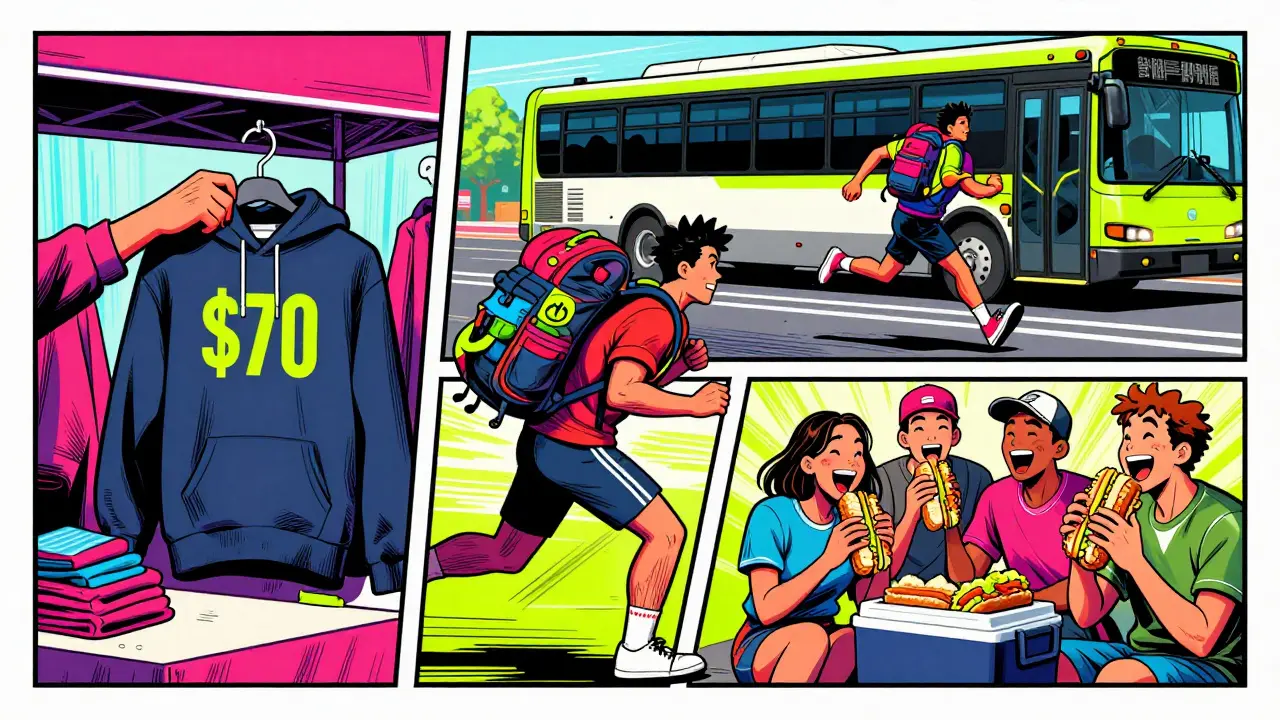
Merchandise adds up fast, too. A simple band tee costs $40. A hoodie? $70. A limited-edition poster? $60. If you’re buying for friends or just can’t resist that neon glow stick hat, you could easily drop another $100-$200.
Most people forget about the stuff they need to bring - or didn’t plan for. If you’re camping, you’ll need a tent, sleeping bag, air mattress, and maybe a portable charger. A decent camping setup runs $200-$400. If you already own it, great. If not, that’s a one-time cost you didn’t budget for.
Transportation is another silent budget killer. Gas, rideshares, or even a train ticket to the festival site can add $100-$300. For those flying in, a round-trip ticket to Indio, California (Coachella’s location) can cost $400-$800 depending on when you book. And don’t forget airport parking or shuttle fees.
Even weather matters. A sudden rainstorm at Glastonbury or Bonnaroo means you’ll need waterproof gear - boots, ponchos, tarps. If you didn’t pack for it, you’ll buy it there. And prices triple. A $25 raincoat at home becomes $55 at the festival.
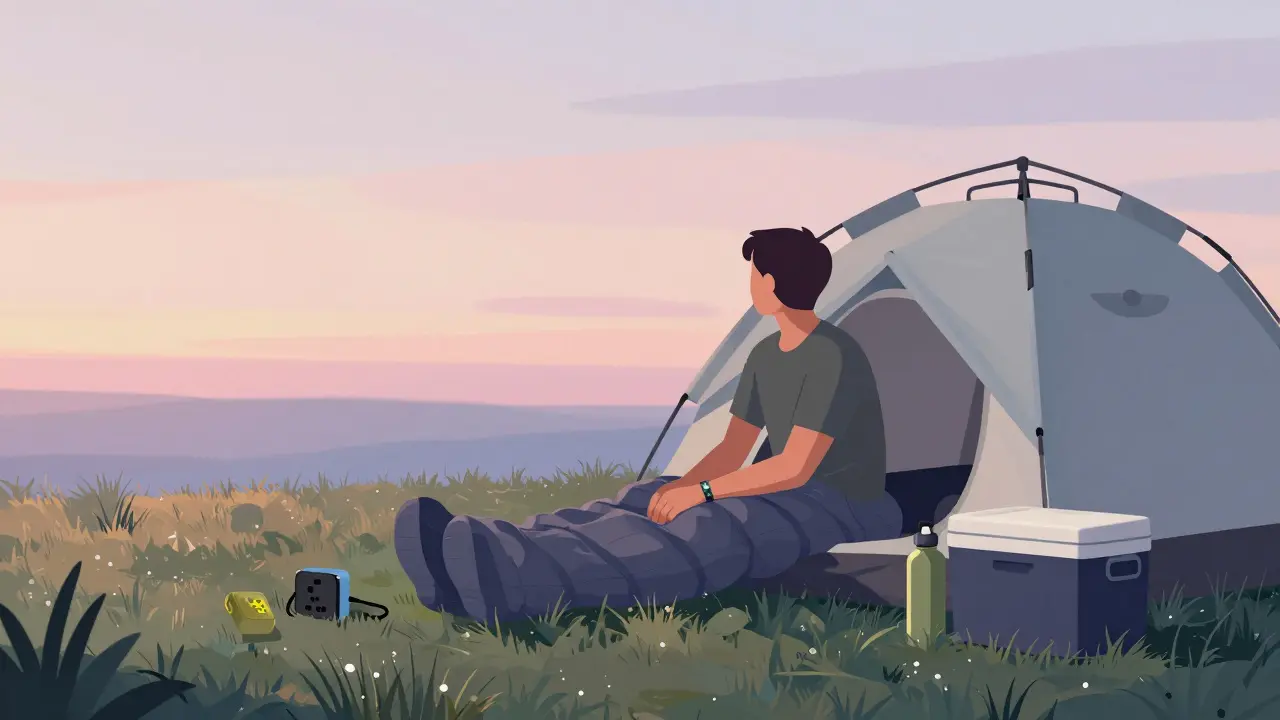
Not everyone spends $1,500. Many festival-goers cut corners smartly. Some camp with friends and split gear. Others bring their own food - coolers are allowed at festivals like Firefly and Outside Lands. One Reddit user shared they saved $300 by packing peanut butter sandwiches, energy bars, and a refillable water bottle.
Buying tickets early helps. Most festivals offer tiered pricing. The first 10,000 tickets are often 30% cheaper than last-minute ones. A $500 ticket can drop to $350 if you buy six months ahead.
Some use payment plans. Coachella, for example, lets you pay in three installments. That spreads the cost over months instead of one lump sum. Others skip VIP perks. You don’t need a private bathroom or air-conditioned lounge to enjoy the music.
And then there’s the resale market. StubHub and SeatGeek have made it easier to buy tickets at face value or even below. A 2025 survey by Festival Insider found 27% of attendees bought their tickets secondhand - saving an average of $110 per person.
Festival prices keep rising. Inflation, labor costs, and insurance premiums have pushed ticket prices up 18% since 2022. Organizers say it’s because of stricter safety rules, more sanitation stations, and higher artist fees. But fans are pushing back. Some festivals now offer “pay what you can” options for students or low-income attendees. Bonnaroo’s 2025 program gave away 500 free tickets to local community groups.
More festivals are adding free shuttles, water refill stations, and phone-charging zones. These aren’t luxury perks - they’re necessities. One attendee at Electric Daisy Carnival said, “I saved $70 because I didn’t have to buy a $10 charging cable.”
As for merch, some artists are testing digital-only merch - QR codes that unlock exclusive wallpapers or NFTs. It’s still early, but it could cut down on physical product costs.
A 2025 survey of 1,200 festival-goers across North America showed:
Those who camped and brought their own food spent under $800. Those who flew in, stayed in hotels, and bought everything on-site hit $2,000+.
For many, yes. A weekend at a music festival isn’t just a concert - it’s a memory. People talk about seeing their favorite band for the first time, dancing with strangers who became friends, or waking up to a sunrise set. The money spent isn’t just on tickets - it’s on connection, freedom, and moments you can’t get from a screen.
But if you’re on a tight budget, it’s not impossible. Start small. Go to a local festival with free admission. Bring your own food. Share a tent. Skip the merch. You can still have an unforgettable experience without maxing out your credit card.
Yes, going with a group can cut costs significantly. Splitting a camping tent, sharing food, and carpooling can save $200-$500 per person. Many festivals offer group ticket discounts if you buy 4 or more at once. Plus, sharing gear like coolers, portable chargers, or tarps reduces individual spending.
Most major festivals allow sealed, non-alcoholic drinks and pre-packaged snacks. Some, like Outside Lands and Shaky Knees, even let you bring in a small cooler. But rules vary - always check the festival’s website. Bringing your own food can save you $100-$200, especially if you pack protein bars, fruit, and sandwiches.
Rarely. Most festivals sell out early, and prices only go up as the event nears. The best deals are in the first ticket tiers, which often sell out within hours. Waiting until the last minute usually means paying full price or buying from resellers - who charge more. If tickets are still available two weeks out, you might find a slight discount, but don’t count on it.
Yes. Some festivals give away free tickets through contests, radio promotions, or volunteer programs. Bonnaroo, for example, offers free passes to volunteers who work four-hour shifts. Local radio stations often run giveaways. College radio stations and fan clubs sometimes have early access codes. And if you’re a student, check for student discounts - some festivals offer 20% off with a valid ID.
Set a merch budget before you go - say, $50. Stick to it. Wait until the last day to buy; prices sometimes drop as the festival ends. Some artists sell leftover merch online after the event, often at 30-50% off. And remember: you don’t need to buy everything. One shirt or hat is often enough to remember the experience.
If you’re planning your next festival trip, start with a realistic budget. Know what you’re paying for - and what you can skip. The music will still be loud, the crowd still electric, and the memories still lasting - even if you didn’t spend $1,500.

michael T
Y’all act like spending $1,500 is some kind of crime. Bro, I paid $2,200 last year and I still dream about that sunrise set with Tame Impala. It wasn’t just a festival-it was a spiritual awakening. I cried when the bass dropped. I hugged three strangers. I fell asleep covered in glitter and mud. That’s not spending-that’s investing in your soul.
Christina Kooiman
Actually, the data shows the average spend is $1,220-not $1,500-and that’s including travel, which many people don’t account for. Also, you can’t just say ‘it’s worth it’ without acknowledging inflation, labor exploitation, and corporate greed behind these events. The real cost isn’t on your credit card-it’s on the workers who clean up after you.
Pamela Watson
OMG YES I DID THIS LAST YEAR AND I SPENT $1,800 AND I WOULDN’T CHANGE A THING 😍 I BOUGHT A NEON GLOW STICK HAT AND A HOODIE AND A TATTOO STICKER AND A $14 BEER AND I CRIED WHEN THE DJ PLAYED MY SONG 😭
Jeremy Chick
You’re all overthinking this. Go to a festival. Buy a ticket. Eat the $18 burger. Dance like no one’s watching. If you’re stressing about $1,200, you’re not ready for the experience. Life’s short. Get weird.
Lissa Veldhuis
Everyone’s acting like they’re saving the world by bringing a cooler. Newsflash: you still paid $500 for a ticket to watch people in glitter scream at a screen. The real scam is the ‘I’m so authentic’ vibe when you’re just another consumer with a reusable water bottle
Addison Smart
There’s value in both sides. Yes, festivals are expensive-but they’re also one of the last spaces where people connect without phones, without algorithms, without performative self-expression. The $1,220 average? That’s not just money. It’s the price of belonging. I’ve met my best friends at festivals. I’ve cried in the mud with people who became family. You can’t quantify that with a spreadsheet.
Renea Maxima
What if the real cost isn’t money… but the illusion that you need to be somewhere to feel alive? Maybe the festival is just a mirror. And we’re all just paying to see our own loneliness dressed in neon.
Michael Jones
Stop counting dollars and start counting moments. One sunrise. One dance with a stranger. One song that changes your life. That’s the currency. The rest is just noise. Go. Feel. Be there. The money? That’s just the ticket to your own awakening
Stephanie Serblowski
Y’all are forgetting the real MVPs: the volunteers. I worked 4 hours at Bonnaroo last year and got a free ticket + merch + a lifetime supply of snacks. If you’re broke, don’t just complain-volunteer. The system’s rigged, but it’s not broken. You just gotta hack it. 🙌
David Smith
Wow. So now we’re romanticizing consumerism? People are literally paying $2,000 to sleep in a field with 70,000 strangers while corporations profit off their thirst for ‘authenticity.’ This isn’t culture. It’s capitalism with glitter.
allison berroteran
I went to my first local festival this year-it was free, had 3 bands, and a taco truck that let me pay what I could. I brought my own blanket, drank water from a fountain, and danced with my dog. I spent $12. And I left happier than I’ve been in years. You don’t need Coachella to feel alive. You just need to show up, be present, and let the music move you. The rest? Just marketing.